How Does Razor Wire Provide Maximum Perimeter Security for Critical Facilities?
Introduction
When security failure is not an option, facility protection systems must go beyond ordinary fencing. Many industrial sites, energy plants, and border infrastructures face intrusion risks that basic fencing cannot stop. In these environments, razor wire becomes a critical physical security layer.
Unlike conventional fencing, razor wire is designed to actively prevent contact. Its sharp blade structure creates a barrier that is not only difficult to pass, but also discourages any attempt at climbing or cutting.
What Is Razor Wire
Razor wire is a high-security perimeter protection material made from a steel core wire combined with stamped metal strips that form sharp cutting edges.
These metal strips are tightly wrapped around the core wire to form continuous coils or linear reinforcement barriers. The result is a structure that increases both physical resistance and psychological deterrence.
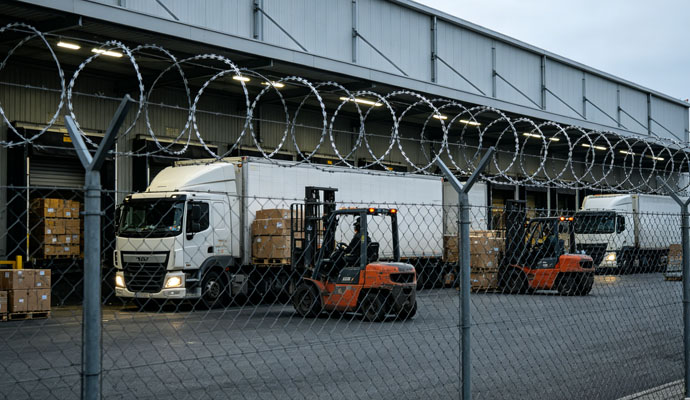
In practical use, it is often installed on fences, walls, or ground-level barriers to reinforce existing security systems.
Structural Forms of Razor Wire
Spiral Coil System
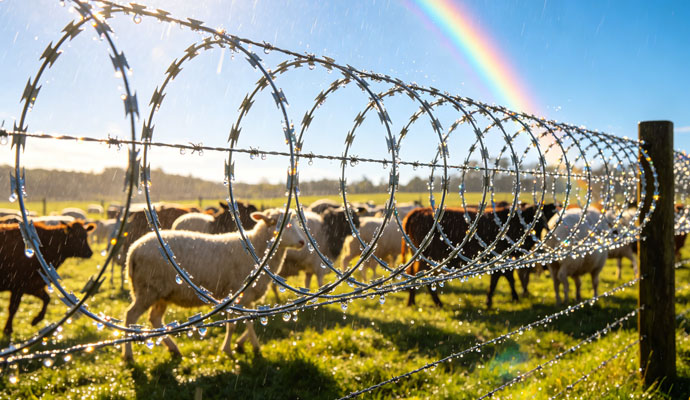
This is the most widely used configuration. The wire is formed into expandable spiral loops that create depth and layered obstruction. It is commonly installed on perimeter fences and boundary walls.
Linear Reinforcement Strip
In this form, razor wire is installed in a straight line, usually fixed on top of walls. It is suitable for sites where space is limited but security reinforcement is required.
Interlocked Coil Network
This configuration uses multiple coils connected together to form a denser barrier. It is typically used in high-risk facilities requiring stronger intrusion resistance.
Material Options
Hot-Dip Galvanized Steel
This material provides basic corrosion resistance and is widely used in standard outdoor security projects. It balances cost and durability.
Stainless Steel Grade Wire
Stainless steel version is designed for long-term exposure environments such as coastal areas, chemical zones, and high humidity regions.
How Razor Wire Works in Security Systems
The effectiveness of razor wire is not based on a single factor, but a combination of physical design and behavioral deterrence.
First, the blade edges create immediate injury risk, discouraging direct contact.
Second, the structure increases crossing time, making intrusion attempts slower and more detectable.
Third, it reinforces psychological resistance, often stopping intrusion before physical contact occurs.
Because of these combined effects, razor wire is widely used in multi-layer perimeter defense systems.
Selection Criteria for Razor Wire
Choosing the right system depends on real site conditions rather than product appearance.
Threat level: Higher risk sites require multi-coil reinforcement systems.
Installation position: Wall-top, fence-top, or ground barrier all require different layouts.
Environmental exposure: Coastal and chemical environments require stainless steel materials.
Maintenance expectation: Long-term unattended sites benefit from corrosion-resistant coatings.
Common Field Issues
Coating Wear
Long-term exposure to weather conditions may reduce surface protection and lead to gradual corrosion.
Structural Relaxation
Improper tensioning during installation can cause coil loosening over time.
Physical Deformation
External force or improper handling during transport may affect coil shape and installation performance.
Maintenance Practice
Razor wire systems are generally low maintenance, but inspection is still important for long-term safety.
- Check fixing points and support structures periodically
- Inspect after storms or strong wind events
- Monitor corrosion in exposed environments
- Replace damaged sections when structural integrity is affected
Engineering Application Cases
Case 1: Power Substation Protection Project
A high-voltage substation used spiral razor wire on perimeter fencing to prevent unauthorized access and enhance electrical infrastructure security.
Case 2: Remote Border Security Installation
Multi-layer coil systems were deployed along remote terrain boundaries where surveillance coverage was limited, providing physical delay against intrusion.
Case 3: Industrial Chemical Facility Protection
Stainless steel razor wire was used in a corrosive environment to ensure long-term durability and stable perimeter defense performance.
Conclusion
Razor wire remains a core component in modern perimeter protection strategies. Its value lies not only in physical obstruction, but in its ability to delay, deter, and disrupt intrusion attempts effectively.
When correctly selected and installed, it becomes an essential layer in securing high-risk facilities and critical infrastructure systems.
FAQ
Where is razor wire most commonly used
It is used in industrial sites, military zones, border areas, and infrastructure protection systems.
Is razor wire a standalone security solution
No, it is usually combined with fencing or wall systems as part of a layered security design.
What is the lifespan of razor wire
Depending on material, it can last 10–25 years under proper conditions.
Can razor wire be used in urban areas
Yes, but flat systems are usually preferred for safety and visual control.
What is the main advantage of razor wire
It provides strong deterrence with relatively low installation and maintenance cost.